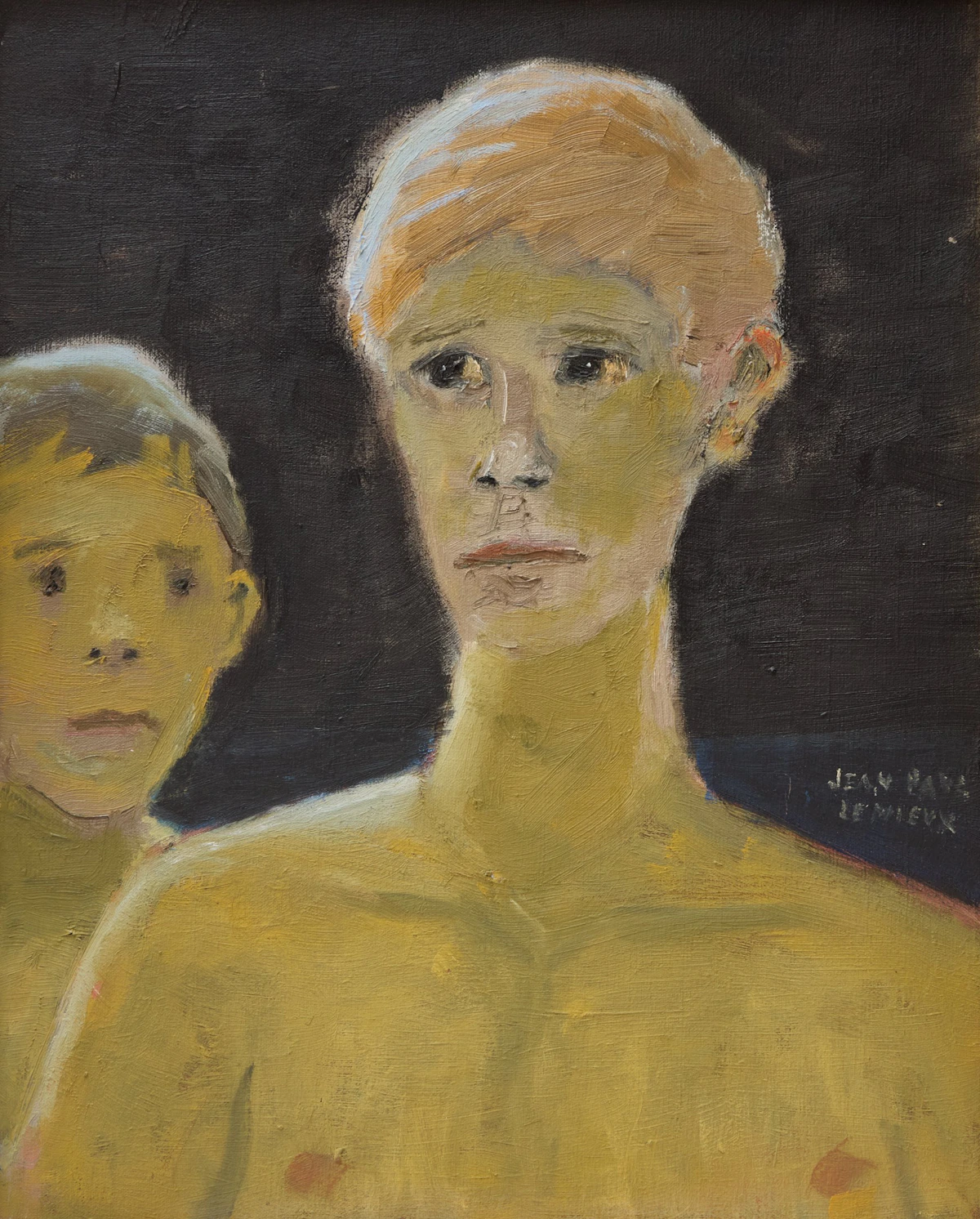
signed middle right; titled on the stretcher on the reverse
20 × 16 in (50.8 × 40.6 cm)
Collection of Michel Bouchard
Galerie Lacerte Art Contemporain, Montreal, 2019-2020
Private Collection, Montreal
Jacques Thériault, “J.-P. Lemieux s’explique sur sa nostalgie,” Le Devoir, Montreal, September 18, 1971, page 11
Michèle Grandbois, Jean-Paul Riopelle: Life & Work [online publication], Art Canada Institute, Toronto, 2016, page 55.
Guy Robert, Lemieux, Gage Publishing, 1978, pages 209, 244.
As Quebec was experiencing a decade of artistic innovation with flourishing avant-garde abstract movements, Jean Paul Lemieux himself turned away from narrative to focus on the flat space of the picture plane. He never fully embraced abstraction, however, viewing the movement as the expression of a society in decline. In his view, the work of his contemporaries reflected the tension and mechanization of their era, as well as the frightening future these developments seemed to promise. Lemieux claimed that “an anxious era will not produce tranquil art. Painting today is in transition. It is tormented, disturbed, and seeking, like contemporary humanity, new modes of expression.”
Portraits occupy a strong presence in Lemieux’s multi-faceted body of work. Throughout his career he depicted his sitters in a frontal stance with a direct view into the facial expression. Guy Robert, on the subject of the artist’s portraits, writes that “Lemieux believes that the face has a message to impart all through life, and a good deal of his work has been concerned with capturing the characteristic expressions of different stages of life from cradle to the deathbed.”
In Baigneurs du soir, two young men are shown from the waist up against a brooding, dark sky. The contrast between the exposed torsos of the men and the nearly black sky heightens their vulnerability, despite the seemingly innocent theme of night swimming, as suggested by the title. As Michèle Grandbois writes, Lemieux “expressed the perilous human condition by showing figures isolated in their personal solitude.”
Inspiration for documenting human expression came from an interest in American Social Realism in his early career, particularly the movement’s interest in showcasing the lives of the daily lives of working class people. Later in life, Lemieux’s portraits were influenced by Edvard Munch and the Expressionist school of painting, as they seek to portray anxiety and the artist’s “dark, tragic vision of the tormented historical era he was living through.”
This painting was in the collection of Michel Bouchard, a Quebec City art collector and a former student of Jean Paul Lemieux at the École des beaux-arts.
