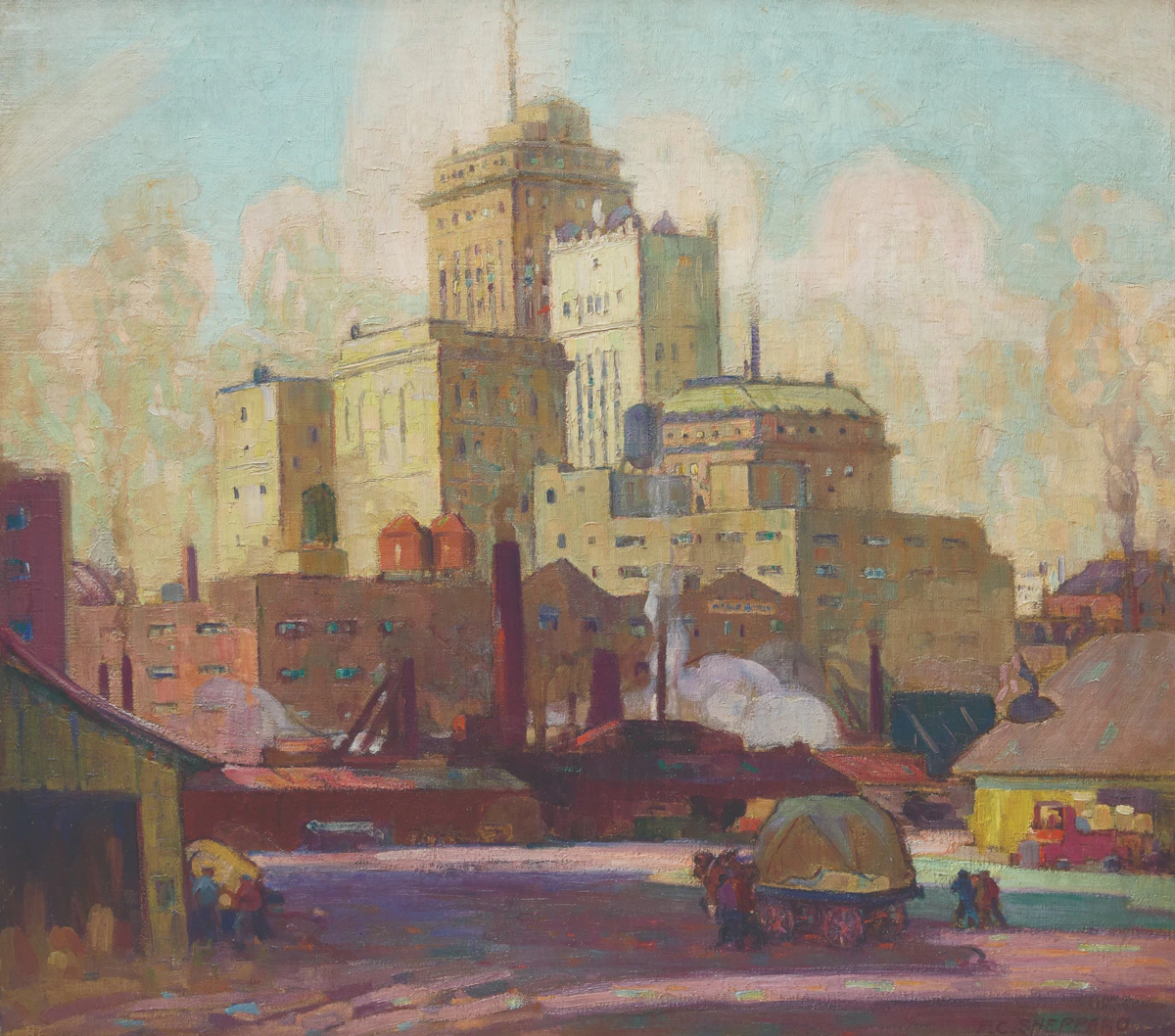
signed lower right; estate stamp no. LG144 on the reverse
34 × 38 in (86.4 × 96.5 cm)
The Artist (1879-1965)
By descent to Bernice Fenwick Martin (1902-1999)
By descent to a Private Collection
53rd Annual Exhibition, Ontario Society of Artists, 7-29 March 1925
49th Exhibition of the Royal Canadian Academy of Arts, Art Association of Montreal, Montreal, 24 November 1927-2 January 1928, no. 206
“Pictures at Exhibition of Royal Canadian Academy,” The Globe (Toronto), 20 November 1914, page 7
“C.N.E. Directors Buy Pictures Exhibited,” The Globe (Toronto), 15 September 1915, page 8
“Art and Artists,” The Globe (Toronto), 23 November 1918, page 10
“Toronto’s Own Art Gallery A Haven of Delight To-day,” The Evening Telegram (Toronto), 6 June 1925, page 31
“R.F. Gagen Dies Suddenly While In Art Gallery,” The Evening Telegram (Toronto), 3 March 1926
Catalogue of the Forty-Ninth Exhibition of the Royal Canadian Academy of Arts, Montreal, 1927, no. 206, page 19
Edith G. Firth, Toronto in Art: 150 Years Through Artists’ Eyes, Toronto, 1983, reproduced on the cover and pages 94-95
Tom Smart, Peter Clapham Sheppard: His Life and Work, Richmond Hill, 2018, reproduced page 145 as The City
“Skyline View, showing New C.P.R. Hotel – Toronto,” Gift of Norman Attikin, Baldwin Collection of Canadiana, Toronto Public Library, PC_5240, https://digitalarchive.tpl.ca/objects/384213/skyline-view-showing-new-cpr-hotel--toronto?ctx=494d8409aabdbbff7f4a1698f6f5bb80e3a4c29a&idx=18, accessed 2 October 2026
Peter Clapham Sheppard brought out the humanity of the cities in which he painted, and none more than Toronto where he spent most of his career. Works such as The Bridge Builders, Construction, Bloor Street Viaduct (1915, sold Cowley Abbott 28 May 2025) and the Montreal scene, Hôtel du Canada, Winter, Marché Bonsecours (1931, sold Cowley Abbott 26 November 2025) exemplify his capacity to evoke the grand and the intimate, and the present painting synthesises those effects as only Sheppard could. Research following the publication of Tom Smart’s defining monograph, Peter Clapham Sheppard: His Life and Work (2018) uncovered documentation confirming the painting The City is not the present painting begging the question, if the present painting is not The City, what is it?
Astute observers will see a resemblance with Robert F. Gagen’s Temples of Commerce (1914) in the collection of the Toronto Public Library. Looking north from Toronto Harbour, Gagen presents a gleaming new Toronto rising from a dark, smokey and sooty Toronto a decade after the fire of 19-20 April 1904. On an axis from the harbour to the new temples of commerce straddling Yonge at King Street, Gagen observed Toronto’s economic foundation and future. Reading from left to right, at the southwest corner of King and Yonge Streets is the Dominion Bank Building (1914). On the northeast corner is the Royal Bank of Canada, the Empire’s tallest building upon completion in 1915. At the southeast corner is the Canadian Pacific Railway Building (1913), and rightmost, immediately south on Yonge at Colborne Street, is the Trader’s Bank Building that was the tallest in the Empire upon its completion in 1905.
A little more than a decade after Gagen painted Temples of Commerce, Sheppard painted the scene as he painted the city, namely as someone who knew its shabby byways and was not put off by the stink of the streets or the guttural of toilers. He conveyed those sensations keenly in his paintings, and here with his distinct palette favouring Naples yellow, magenta, and ultramarine all infused with white he brought it to life.
Sheppard moved Gagen’s axis westward and his view north to the towers at King and Yonge is from the south side of Union Station near the fenced-in area in the bottom-left of Toronto 1923, Looking North East from A.R. Williams Machinery. The vapour rising in Sheppard’s painting comes from the site of the future Dominion Public Building that was built in phases from 1929 to 1935 and still occupies the south side of Front Street between Bay and Yonge Streets. The low red brick buildings on the north side of Front were built by the 1910s, and the taupe eight storey building, partially blocking the view of the Trader’s Bank, was finished in 1923. By around 1929 there was an office block at the northeast corner of Front and Bay Sheppard shows empty. Accordingly, the painting was composed around 1926.
Following Gagen’s sudden death on 2 March working on the 1926 exhibition of the Ontario Society of Artists, the Art Gallery of Toronto held a memorial exhibition that opened the next month and included Temples of Commerce. While the exhibition appears to have not been reviewed in the daily press, Temples of Commerce was commented upon in its first exhibition, the following year, and in reviews of exhibitions at the Art Museum of Toronto and, its later iteration, the Art Gallery of Toronto. Its success as a new artistic departure was reiterated in The Telegram’s 3 March 1926 obituary.
Within these brackets we cautiously suggest the present painting is Commerce that was exhibited at the Forty-Ninth Exhibition of the Royal Canadian Academy of Arts held at the Art Association of Montreal from 24 November 1927 to 2 January 1928. Having been able to see Gagen’s Temples of Commerce on multiple occasions over the past decade and having consistently thought about and painted the city, it is plausible Gagen’s painting tipped Sheppard to reinvent the composition for a new decade. Toronto’s commercial district went west through the twentieth century. In this century, it moved south of Sheppard’s vantage and continues to evolve as each of those temples of commerce has been superseded by towers that were unimaginable a century ago. Still, those towers stand, continuing to evolve for new purposes and successes, like the city itself.
We extend our thanks to Gregory Humeniuk, independent art historian, curator and consultant, for contributing the preceding essay.
