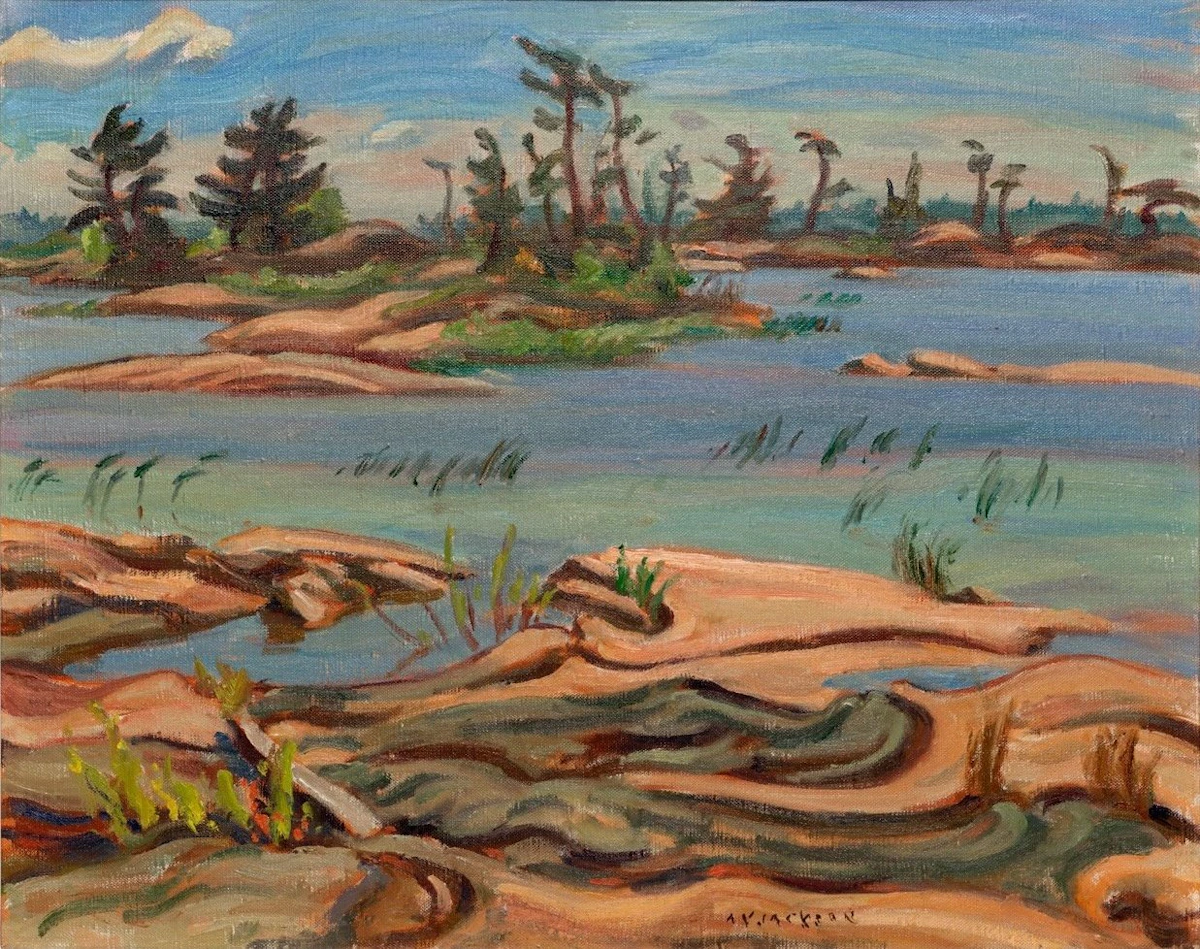
signed lower right; titled and dated 1952 on a gallery label on the reverse
16 × 20.25 in (40.6 × 51.4 cm)
Walter Klinkhoff Gallery, Montreal
Private Collection, Winnipeg
A.K. Prakash & Associates Inc., Toronto
Private Collection, Toronto
A.Y. Jackson, A Painter’s Country, Vancouver/Toronto, 1958, page 25
Naomi Jackson Groves, A.Y.’s Canada, Toronto/Vancouver, 1968, pages 108, 110
Dennis Reid, A Concise History of Canadian Painting, second edition, Toronto, 1988, page 247
In the spring of 1913, A.Y. Jackson made his first of many trips to Georgian Bay. Through Lawren Harris, he was connected with Dr. MacCallum, who had a cottage in the area and offered to host Jackson and support him financially, on the condition that he take a space in The Studio Building in Toronto. MacCallum also introduced Jackson to Tom Thomson, a friendship that helped lay the groundwork for the uniquely Canadian art movement that would be known as the Group of Seven. In the summer of 1919, Jackson returned to paint in Georgian Bay, and that work supplied material for the Group’s first exhibition in Toronto the following spring.
For Jackson, land exists as more than subject matter. Following the end of the First World War, Group of Seven artists turned to the Canadian landscape at a moment when the country was beginning to think about its own identity. They believed this identity could be discovered through direct engagement with the land itself and immersing themselves in its distinctive character rather than relying on the conventions of European painting. For Jackson, who had served in the war and witnessed its devastation across Europe, this relationship carried a deeply personal significance. Georgian Bay became a place of recovery, one to which he returned to even after the disbanding of the Group of Seven. His connection to Georgian Bay was both intimate and national, rooted in personal experience while inseparable from a broader search for Canadian identity. Part of Jackson’s enduring appeal lies in his ability to transform the particular into the universal: a stretch of shoreline becomes an expression of resilience and growth, impacted by the human relationship with the land. Through his sustained attention to this one place, Jackson offers a vision of belonging, and his legacy endures through his paintings and the role they played in shaping how a nation came to see itself.
Georgian Bay was a region that Jackson revisited regularly throughout his prolific career, referring to the area as his “happy hunting ground.” He enjoyed the opportunity to paddle around islands and explore the web of channels, affording him near-infinite vistas for sketching. Over repeated visits, this landscape shaped a visual language of its own: iconic rocky terrain, windswept pines and a rugged shoreline. That language is evident in this 1952 oil painting, where the viewer looks out onto a layered, high horizon line, with rocky peninsulas receding into the distance. The curving lines of the granite bedrock in the foreground are quintessentially Jackson, as are the many subtle yet skillful variations in earth tones. His fluid brushstrokes guide the viewer’s eye across the rock and out toward the water, while the blues, oranges and greens of the pines and shoreline give the scene a tranquil feeling.
The volume of work that A.Y. Jackson produced in his lifetime is incredible. Georgian Bay was painted at a time when Jackson was not only keeping up with an increased demand for his artwork, while also regularly contributing to newspapers and magazines, participating in a retrospective exhibition and writing his autobiography. As Dennis Reid remarked, it is a testament to the artist that well into the 1950s he still held court as the “heart and soul of painting in the city – in fact in most of English-speaking Canada.”
The sketch for this canvas is in the collection of Nelles Douglas (Jack) Young. Young was A.Y. Jackson's friend, patron and financial advisor. Young acquired and built a fine collection of Canadian art.
