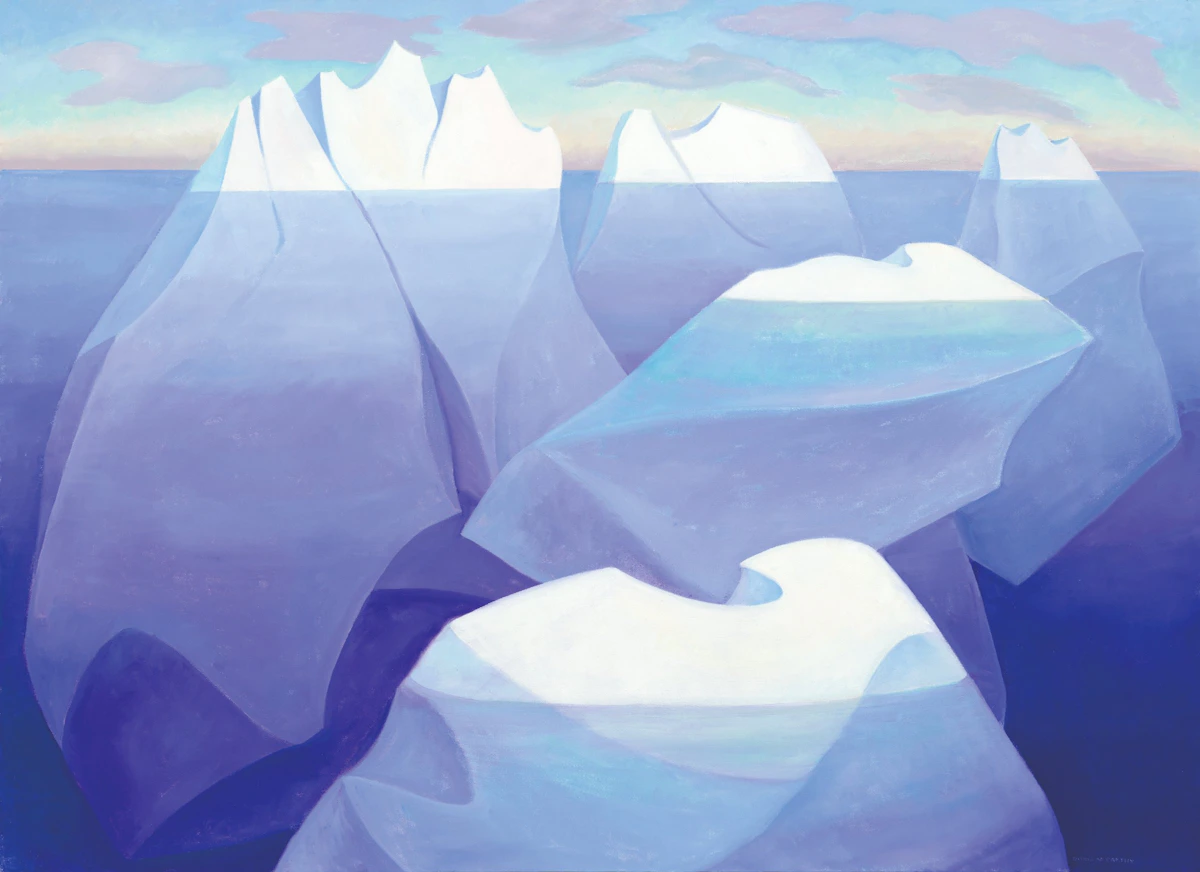
signed lower right; titled on the stretcher; dated 12 September 1996 ("960912") on the reverse; titled and dated on the gallery label on the reverse
48 × 66 in (121.9 × 167.6 cm)
Wynick/Tuck Gallery, Toronto
Private Collection, Toronto
Everything Which is Yes. Works by Doris McCarthy, Doris McCarthy Gallery, Toronto, 11 March-25 April 2004
William Moore, “Heart of Vision” in Celebrating Life: The Art of Doris McCarthy, Kleinburg, 1999, pages 180, 199
Stuart Reid, “Island Sketches: Thoughts on the Watercolour Paintings of Doris McCarthy” in Celebrating Life: The Art of Doris McCarthy, Kleinburg, 1999, page 214
Nicole Collins and David Urban, Doris McCarthy: Everything Which is Yes, Toronto, 2004, reproduced
A love of nature was central to the character of the young Doris McCarthy. Her father, whom she recalled as “one of the early conservationists,” instilled in her the belief that “nature and the out-of-doors were an important part of my heritage.” McCarthy would eventually combine this deep appreciation for the natural world with her passion for painting. While attending Malvern College in Toronto, she took introductory art classes for high-school students at the Ontario College of Art. Although she felt little of technical importance was gained from the classes, they introduced her to a new generation of Canadian landscape painters, including the Group of Seven. The Saturday morning classes were taught by Group of Seven member Arthur Lismer, who quickly recognized the young McCarthy’s talent. In May 1926, he awarded the fifteen-year-old a full-time scholarship to the Ontario College of Art, where she began her studies that October. At the time, George Agnew Reid served as principal, with Lismer as vice-principal.
At the Ontario College of Art, McCarthy studied figure painting and composition under J.W. Beatty. Deeply rooted in the academic traditions of the nineteenth century, Beatty had little interest in the modernist approach championed by the Group of Seven. McCarthy’s student years coincided with a period of profound change in Canadian art. By the end of the 1920s, a growing divide had emerged between the Group of Seven and the academic establishment. By the early 1930s, however, the idea of a distinctly national school of painting was gaining momentum, culminating in the formation of the Canadian Group of Painters in 1933. That same year, McCarthy attended the Ontario Training College for Technical Teachers in Hamilton to obtain her teaching certification, where she studied under Hortense Gordon. The two developed a close relationship, and McCarthy admired Gordon’s approach to art, later recalling that her analysis of design and composition was far ahead of anything she had previously encountered.
By the 1950s and 1960s, McCarthy’s work was evolving in new directions. The growing influence of abstraction in Canadian art was exemplified by Painters Eleven, whose members included Alexandra Luke, Jack Bush, Tom Hodgson, William Ronald, and McCarthy’s former teacher Hortense Gordon. McCarthy had already exhibited alongside several of these artists in group exhibitions, and her own work began to flirt with abstraction. Yet even as the language of Canadian painting was changing dramatically, she remained firmly committed to the landscape as her subject. She turned her attention to the natural forms and rhythms found at ground level, creating increasingly intimate compositions that explored the cadence of land and water. In her hard-edge works of the late 1960s, these observations were reduced to simple structures of shape, colour, and line, reflecting the influence of Post-Painterly Abstraction, Color Field painting, and Minimalism in style and method. The subject, however, remained rooted in the places she experienced firsthand. These increasingly simplified forms and explorations of perceptual change over time would become an important foundation for the next major evolution in her work: the iceberg paintings.
In 1972, the year of her retirement from teaching, McCarthy made her first of many trips to the Canadian Arctic. She was fascinated with the topography of this territory and the new painting opportunities it provided her. Her paintings of icebergs and the Arctic landscape, including The Depths, are considered to be the artist’s best known and most celebrated works. She described her first encounter with an iceberg: “It was almost noon before we reached the berg. This was the first time I had seen the brilliant turquoise and incredible green of the deep crevasses of glacial ice, the results of the enormous pressure of the weight of that great depth of ice, fifteen metres of it visible and more than ten times that depth below the surface.”
In some instances McCarthy painted on site, and other times she took photographs to refer to later in her studio while painting on large canvases. During the latter, she “relied on sensual recollections of light, the wind and weather, the character of the place.” The monumental canvas The Depths would have been completed in the studio, where she effectively preserved the feeling of the crisp air and the still channel of water surrounding the sublime iceberg formations. Their angular, sculptural forms are rendered in delicate shades of lavender, blue, and turquoise, with brilliant white peaks catching the light. This iceberg painting can be seen as a culmination of McCarthy’s artistic development, bringing together the lessons of her traditional and modern landscape training with the nature-based abstractions she explored throughout the previous decade.
Author Stuart Reid praises McCarthy’s Arctic scenes, writing: “Within all her great body of work, gleaned from her travels that have taken her around the world, perhaps the most powerful and poetic works she has completed are those which address the grand, mysterious islands of ice.”
