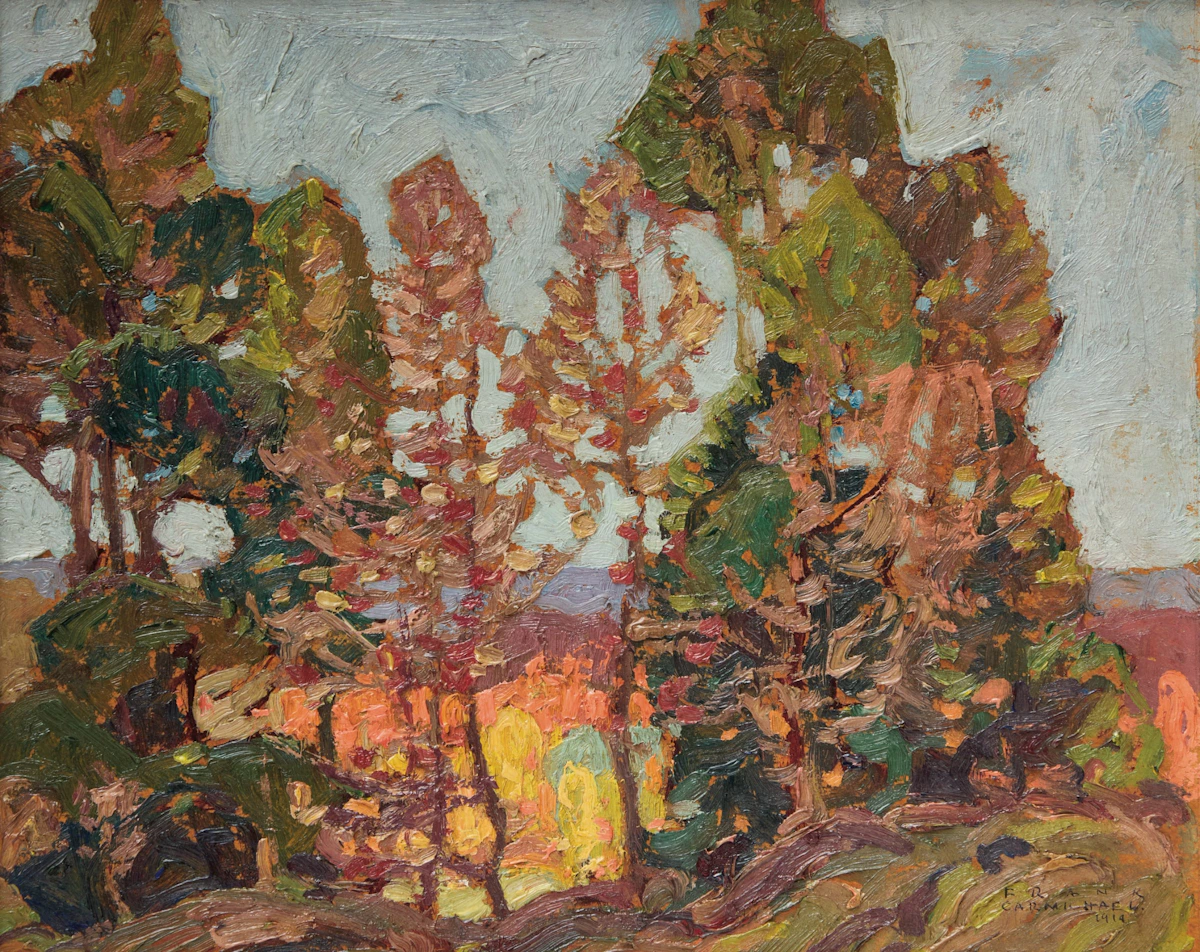
signed and dated 1919 lower right; signed and inscribed “Lansing, Ont.” and "35" on the reverse
9.5 × 12 in (24.1 × 30.5 cm)
Possibly acquired directly from the Artist by Thomas Broley Godfrey
By descent to the present Private Collection, Ontario
In April 1919, Frank and Ada Carmichael purchased a home in Lansing, Ontario, part of today’s North York in Toronto, where they remained for the rest of their lives together. Lansing was at that time quite rural, the built environment minimal relative to the density of downtown Toronto. Their property included a house, one out-building, an orchard of fruit trees, and gardens, and there were some neighbours nearby. By the fall of 1919 when Franklin Carmichael painted this autumn sketch, the Carmichael’s would have had about six months to settle in after having moved from Thornhill where they had lived from 1916 to 1919. The environs in and around Lansing, including the Humber River Valley, provided Carmichael with subject matter for many years, beginning in 1919.
This sketch represents a style Carmichael would become known for in the early 1920s, colourful scenes of forest interiors and traceries of tree silhouettes and branches. Areas of contrasting colour, such as the horizontal bands of orange and purple in the distant hills, guide the viewer deep into the scene. A hazy green sky sets the darker greens and browns of the trees into relief. Dated 1919, it was one of Carmichael’s earliest oil sketches to be completed once settled in Lansing.
It is not possible to know if this sketch was exhibited during Carmichael’s lifetime because, in those years around 1920-1922, he usually showed them as an untitled group of numbered sketches. In the 1920 Exhibition of Small Pictures and Sketches by Members of the Ontario Society of Artists for instance, he exhibited catalogue numbers 19-24 as “Six Sketches.” Normally, Carmichael would submit work to the OSA’s annual Small Pictures exhibition, but he passed on doing so in 1919, perhaps because he was only just beginning a new body of work in Lansing.
Without a title and exhibition history, there is little more that can be known about the journey of this sketch through time. However, it does have an interesting provenance, having been acquired by an accountant who worked for Sampson-Matthews Ltd., Carmichael’s employer beginning in 1922 and where he served as Art Director until 1932. C.A.G. “Chuck” Matthews, the co-founder of Sampson-Matthews Ltd. also became one of the earliest collectors of Carmichael’s work. He owned these four sketches in the McMichael Canadian Collection: Sketch 4 (October), 1920 (1968.25.1); St. Antoine, 1924 (1968.25.3); Green Landscape, circa 1925 (1969.23.3); and Alman’s Trail, 1939 (1968.25.2). It was the Sampson-Matthews circle that offered Carmichael some of his first experiences with serious private collectors who were engaged by his painting.
We extend our thanks to Catharine Mastin, PhD, art historian, curator, and Adjunct Member of the Faculty of Graduate Studies in Art History at York University for contributing the preceding essay. Catharine curated the exhibition Franklin Carmichael: Portrait of a Spiritualist, organized by the National Gallery of Canada, Ottawa, which toured Canada between 1999 and 2001.
