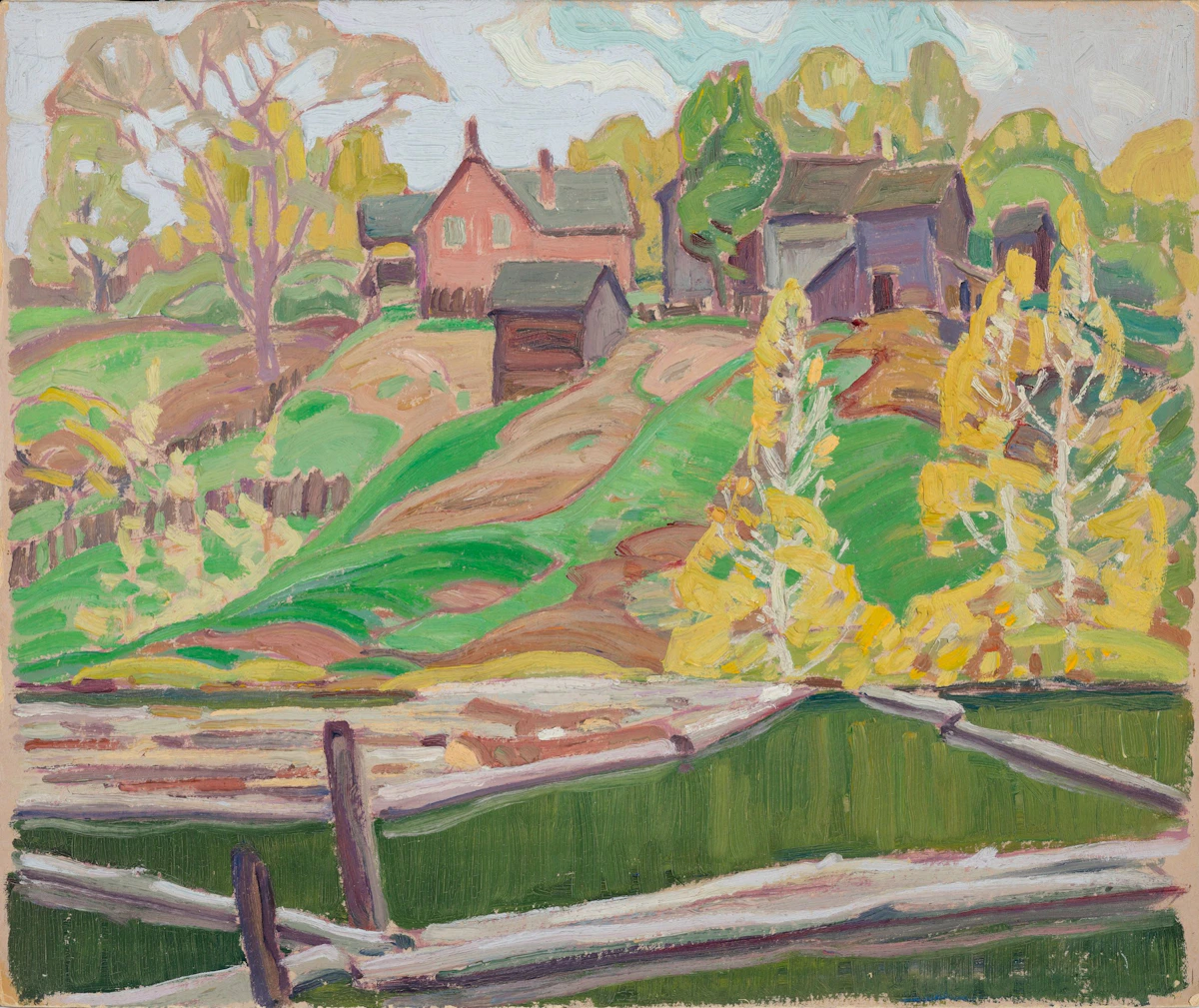
titled, dated 1932, inscribed "OS 50" & "166" with "Estate of Franklin Carmichael" stamp on the reverse
10 × 12 in (25.4 × 30.5 cm)
Estate of the Artist
Collection of Mary Carmichael Mastin
Private Collection
Franklin Carmichael, 1890-1945, Centennial Show, Arts & Letters Club, Toronto, 29 April-19 May 1990, no. 14 as Bracebridge, 1932 (lent by Mary Carmichael Mastin)
"Group Portrait" in Douglas Fetherling, Documents in Canadian Art, Peterborough, 1989, page 64
Franklin Carmichael began to develop an interest in depicting old buildings around 1912. When he arrived in Antwerp in October 1913, the architecture there further inspired him, notably in his first studio watercolour of the Notre Dame Cathedral held in the McMichael Canadian Art Collection (1991.1.2). When he returned to Toronto, Canada in October 1914, his interest in depicting architecture was mostly put on hold while he focused on developing his pure landscapes, those works that came to define his early years showing with the Group of Seven beginning in 1920. But, in 1922, he made his first sketching excursion to the Severn River, and he returned there again in 1923. It was those trips that rekindled Carmichael’s interest in painting old houses and industrial architecture.
In the decade ahead, these subjects engaged him more seriously and he developed a body of work depicting many towns and communities throughout Ontario. He continued this practice well into the 1940s. His first major studio painting of an Ontario community was A Northern Village, 1926 (Orillia Public Library), his award-winning masterpiece for which he won a silver medal at the Sesqui-Centennial International Exhibition: Celebrating One Hundred and Fifty Years of American Independence, June 1-December 1, 1926. For him and A.J. Casson, their goals included documenting derelict buildings and the changing faces of a given place over time. Casson remarked: “I loved to paint villages. I must have covered every village in Ontario, and I’m glad, because they are pretty much gone now. They’ve all changed, fallen down, or been destroyed.”
It was in May 1932 that Carmichael sketched in Bracebridge, Ontario, about 200 kilometres north of Toronto, in the District Municipality of Muskoka. Two focal points in this sketch are the fresh spring growth on the trees, and the cluster of about five buildings nestled against a dense forest. Given the many floating logs jammed along the shoreline below, the water body may have been used for logging operations. Carmichael does not offer more information on his subject through his rather generic title, one that simply documents where he was sketching. In 1932, Carmichael sketched in many places including Elora, Bradford, La Cloche and, in November, at Deux-Rivières, Mattawa, Bissett, and Stonecliff. This is only known sketch he made of a setting in Bracebridge.
There is no known exhibition history of Bracebridge during Carmichael’s lifetime but it was shown at the Arts & Letters Club of Toronto in the Franklin Carmichael, 1890-1945, Centennial Show curated by John Snell, an architect who served as the Club’s curator for eighteen years. Drawn from private collections, including the artist’s family, this exhibition was held concurrently with Carmichael’s landmark exhibition Light & Shadow: The Work of Franklin Carmichael, organized by the McMichael Canadian Art Collection in 1990. Comprised of thirty-five works, the exhibition included one studio watercolour, twenty-five sketches in oil, watercolour and tempera, and nine works on paper. Bracebridge, 1932, was one of several sketches of Ontario village subjects in the exhibition.
We extend our thanks to Catharine Mastin, PhD, art historian, curator, and Adjunct Member of the Faculty of Graduate Studies in Art History at York University for contributing the preceding essay. Catharine curated the exhibition Franklin Carmichael: Portrait of a Spiritualist, organized by the National Gallery of Canada, Ottawa, which toured Canada between 1999 and 2001.
